
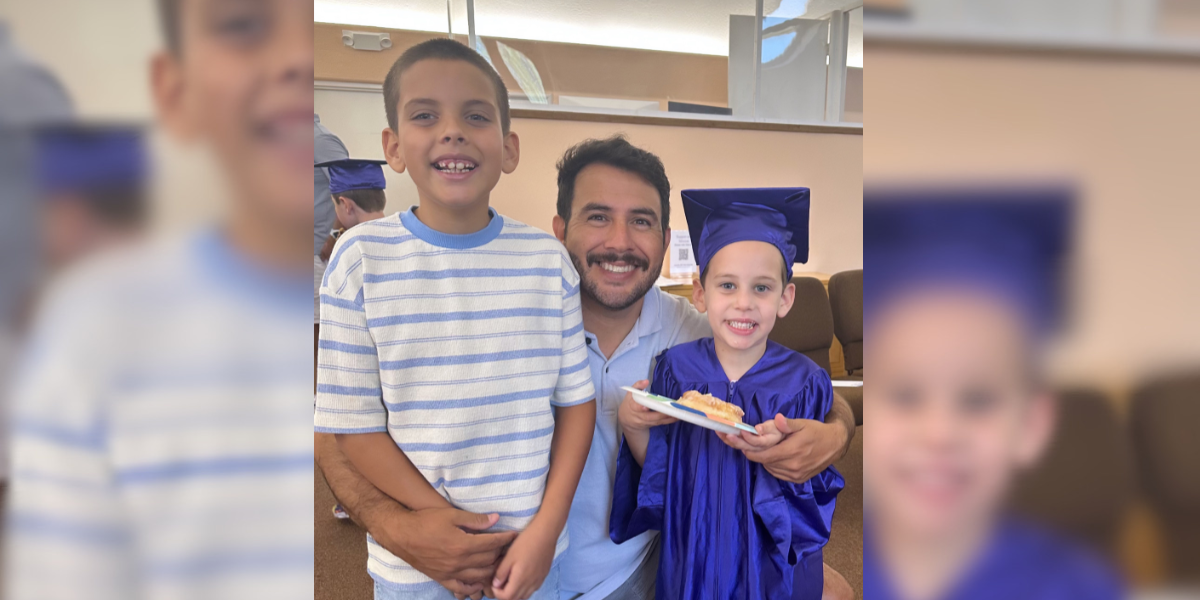
When Brittany and Joshua Romero first connected with SARRC, it was for her oldest son, Zion, who had recently been diagnosed with autism during the pandemic. Like many parents, she was searching for the right environment to help him prepare for kindergarten, and the Community School in Tempe offered exactly that – a supportive, structured setting where children with and without autism learn side by side. Zion attended for a short time, gaining valuable early classroom experience before transitioning into kindergarten.
But it was her younger son, Cruz, whose journey would come to define the family’s experience.
Initially, Brittany and her family considered enrolling Cruz, then 2, as a typically developing student, an important part of the program’s inclusive model. As they moved through the enrollment process, however, SARRC staff gently encouraged the family to explore a formal evaluation.
“That was actually when SARRC’s staff shared very delicately that they saw some risk factors and we should consider getting a formal evaluation,” Brittany recalls. “Behaviors we might have brushed off before suddenly felt more significant.”
Cruz’s journey with SARRC evolved in a different way as his family began pursuing evaluation and support services. During the pandemic, he received his formal diagnosis from SARRC over Zoom. For Brittany, the experience was emotional, but it also brought a greater sense of clarity and understanding. 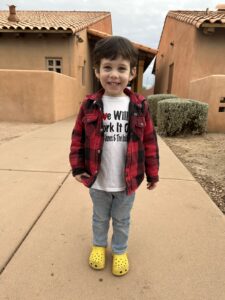
“It was overwhelming at first,” she says. “But at the same time, it felt like we were exactly where we needed to be. The teachers and staff just understood what we were seeing, sometimes before we could even put it into words.”
At the Community School, Cruz quickly became part of a blended classroom of two-year-olds designed to support both children with autism and their neurotypical peers. The environment emphasizes individualized learning, communication development, and social connection – areas that would prove transformative for him.
“The Community School fosters a supportive culture in which all children are encouraged to help each other out. This truly builds a positive classroom environment in which each child can learn at their own pace,” says Beatiz Orr, director of clinical services.
In those early days, Cruz struggled with communication and engagement. Like many young children with emerging signs of autism, expressing his needs could be frustrating. But with consistent support and a low teacher-to-student ratio, progress came steadily.
“You could see the changes happening little by little,” Brittany says. “He started to engage more, to connect. Not just with us, but with other kids. That was huge.”
One of the most meaningful aspects of Cruz’s experience was the way relationships developed naturally in the classroom. Through guided play, structured routines, and intentional teaching, he began building the foundational social skills that would carry into other parts of his life.
For Brittany, the Community School became more than just a place for early education — it became a source of reassurance.
“You don’t feel alone,” she says. “You feel like you have a whole team behind you, celebrating every little win right alongside you.”
Today, Cruz’s success in a general education kindergarten classroom reflects the impact of those early interventions: stronger communication, increased confidence, and a growing ability to navigate the world around him. What began as a plan for a peer model placement ultimately became a journey toward greater understanding, support, and growth.
For the Romero family, that unexpected turn made all the difference.