
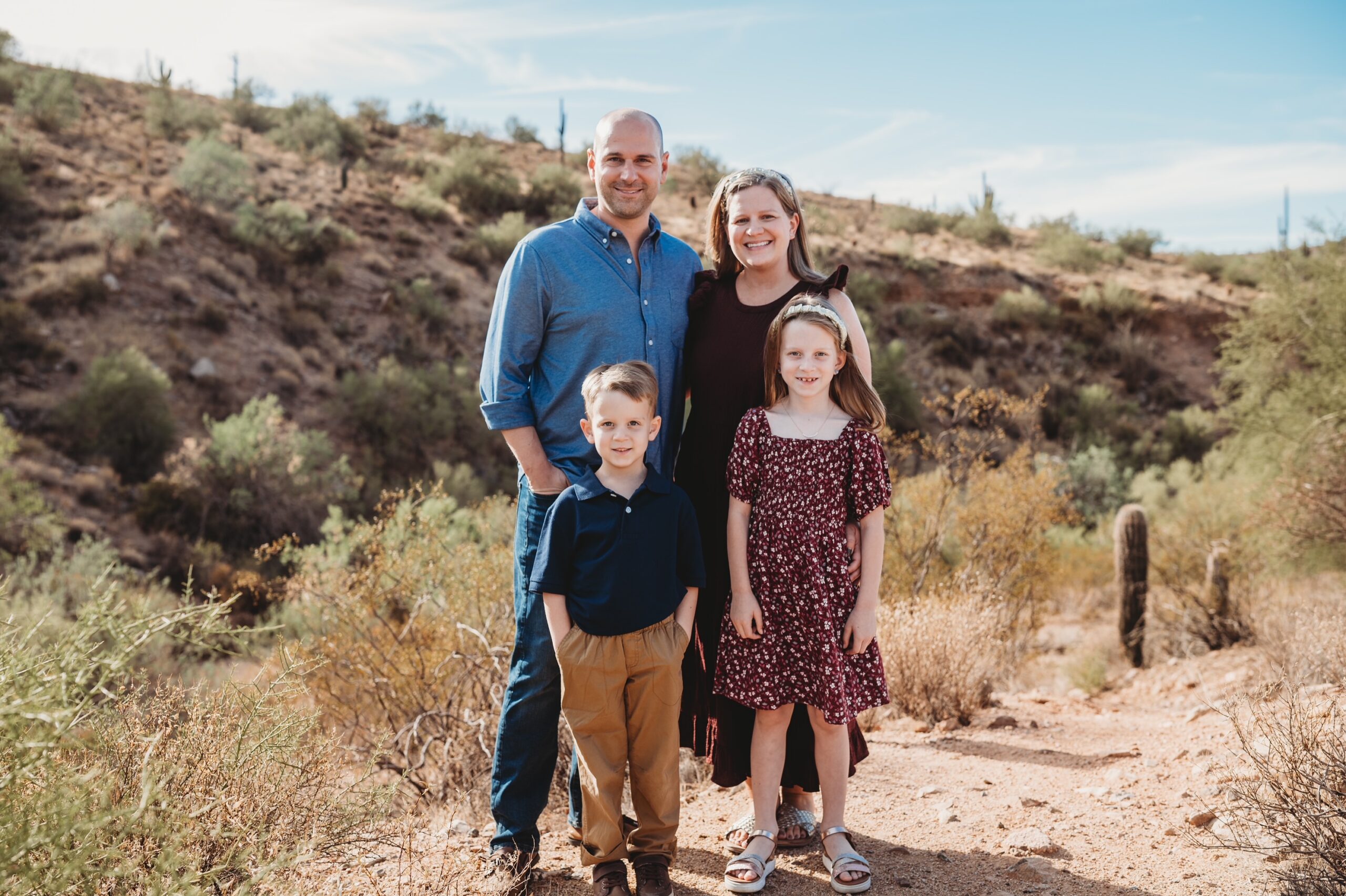
For Jenna and Chad Koskie, the journey with their firstborn child’s unique differences began when their daughter was around 15 months old. Now thriving, Charlotte has developed stronger social skills and continues to build her communication abilities.
Charlotte had lost the few words she had learned and began experiencing significant sensory sensitivities with water and loud noises. She also had difficulty with speech, did not point and struggled to maintain eye contact.
“I have a background in early child development, and I recognized the red flags. But our pediatrician brushed our concerns aside, saying, ‘She’s a girl; she’ll be fine,’” Jenna says. “By 2, she was fully unable to communicate with us, and it was getting harder and harder to be a parent to her.”
Determined to find answers, Jenna continued advocating for Charlotte. By age 2, Charlotte began receiving early intervention services for speech therapy through the State of Arizona. However, professionals continued to downplay her challenges. A family friend eventually connected Jenna with Danny Openden, Ph.D., BCBA, SARRC’s president and CEO, who recommended seeking an autism evaluation.
Just before her third birthday, Charlotte was evaluated at SARRC using NODA (Naturalistic Observation Diagnostic Assessment™), a remote, smartphone-based diagnostic tool. “We recorded Charlotte in different environments — playing with a peer, eating at the table, engaging in her usual activities. It helped us capture her behaviors in natural settings,” Jenna explains.
When the results confirmed that Charlotte had autism, Jenna felt both relief and grief. “I wasn’t shocked — I had known in my heart. But having someone finally listen to me and give us a diagnosis meant we could start making a real plan to support her,” she says.
With a diagnosis in hand, the Koskies immediately enrolled Charlotte in ABA therapy, speech therapy, occupational therapy and feeding therapy. “That journey was exhausting. The waitlists were endless, the paperwork was overwhelming, and all we wanted was to get Charlotte the help she needed,” Jenna shares. “Right when we finally got off the waitlist for ABA, COVID hit and everything moved to in-home therapy sessions.”
Despite the challenges, Charlotte made progress. She attended a typical preschool and later transitioned into a mainstream kindergarten program. However, toward the end of her first-grade year, she began struggling with communication and emotional regulation.
“Our therapist had warned us that between ages 6 and 8, many kids need a ‘tune-up.’ Sure enough, at age 7, Charlotte was having trouble expressing her needs and navigating social situations,” Jenna says.
To address these new challenges, the Koskies enrolled in SARRC’s Parent Training program in late summer 2024. The program provided them with highly individualized tools and strategies to better support Charlotte’s development.
“We met in person once a week at SARRC’s main campus, focusing on communication, social skills, and first-time listening,” Jenna explains. “One of the biggest breakthroughs was helping Charlotte learn to advocate for herself. Before, she would hint at what she wanted, but now she can clearly express her needs.”
The program also helped Jenna and Chad refine their parenting strategies. “When Charlotte is in a ‘red-light zone’ — overstimulated and struggling — we learned that asking her questions only makes things worse. Instead, we need to give her space and provide support in a non-verbal way,” Jenna says. “That was huge for us.”
Charlotte thrived in the program, enjoying the activities so much that she was sad when it ended. SARRC Senior Clinical Consultant Brittani Harris, BCBA, worked with Jenna and Charlotte to access effective strategies that directly supported the family’s struggles.
“During our sessions we played with Barbies and pretend food, two of Charlotte’s favorite activities, to work on independently requesting things she wanted and to tell others when she needed her space or when she did not like something,” Harris says. “In our final weeks of the program, Charlotte was confidently responding and initiating with others and not hiding or relying on mom to speak for her.”
Today, Charlotte, now 8, is thriving in second grade in a mainstream classroom. She has developed stronger social skills and continues to build on her communication abilities. “Every day, she amazes us,” Jenna says proudly.
One of Charlotte’s greatest passions is ballet. “When she was a toddler, she loved spinning — it was a form of stimming for her. She’s been in ballet since she was 2,” Jenna shares. “This year, she auditioned for and performed in ‘The Nutcracker,’ appearing in seven of her company’s 14 shows. Watching her on stage was one of my proudest moments.”
Reflecting on their journey, Jenna has advice for parents just beginning theirs. “Hearing that your child has autism can feel overwhelming. You might grieve the life you imagined for them. But trust me — it’s all going to work out,” she says. “SARRC gave us the tools we needed, and there are organizations out there that will meet you where you are and help you find a path forward.”
The Koskies take comfort in knowing that SARRC will be a resource for them throughout Charlotte’s life. “SARRC supports individuals from infancy through adulthood,” Jenna says. “It’s reassuring to know we have a place to turn, no matter what challenges arise in the future.”