
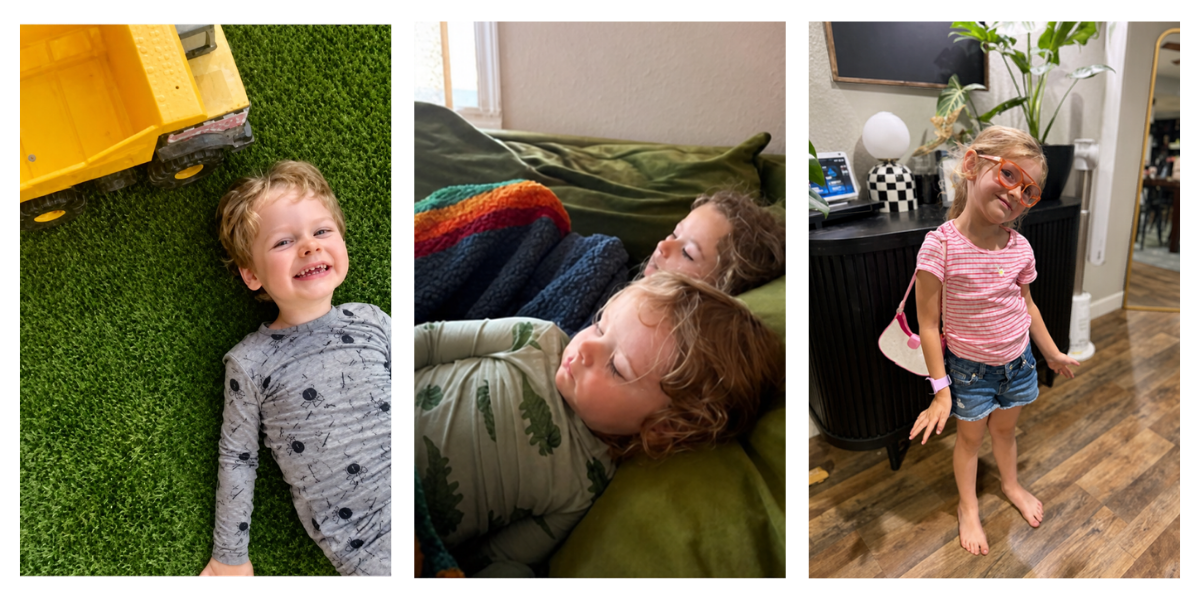
For Jordan Myers, a mother of two, navigating her second child’s autism diagnosis was both a familiar and unique experience. Her daughter Olive, now 5 years old, was diagnosed with autism at age 3. A few years later, she began recognizing similar signs in her son Arlo.
As a first-time mother with a background in nursing, Jordan began noticing soft signs of autism in Olive as early as 3 months old. When she shared her concerns, she was encouraged to wait and see how Olive developed and to consider services such as speech therapy as she got older. Over time, Jordan noticed delays in speech, walking and potty training, along with signs such as stimming and limited social interaction. She continued advocating for her daughter and eventually received an autism diagnosis for Olive at around 3 years old.
“After getting her diagnosis, I felt validated in my feelings and my knowledge. I finally had the answers I needed to get her the support she deserved,” Jordan recalls.
Olive was initially enrolled in a traditional preschool program, but Jordan grew concerned when she wasn’t seeing any signs of progression. Olive was repeating negative phrases, struggling to advance with potty training and avoiding social interactions.
After researching alternative preschool options, Jordan discovered SARRC’s Community School. The blended classrooms, small student-to-teacher ratios and individualized support made it a promising fit for Olive.
At the Community School, Olive is immersed in an inclusive preschool environment where children with and without autism learn, play and grow together. Through play-based learning and individualized support, including ABA-informed teaching practices for children with autism, she has built new skills, gained confidence, and formed meaningful connections with her peers.
“Once I got her into SARRC, she has been a completely different child,” says Jordan. “They got her fully potty trained at 5, helped her improve her communication and supported her growth in reading.”
When Jordan began noticing similar signs in her son Arlo at just under 2 years old, she knew how important early intervention could be and was prepared to advocate for her son’s diagnosis. However, this time her experience was entirely different.
After a brief conversation with Olive’s BCBA at SARRC, Jordan shared her desire to have Arlo evaluated. The very next day, she received a call from SARRC’s Diagnostics Services. After experiencing delays and uncertainty while seeking answers for Olive, Jordan was surprised by how quickly and seamlessly the process moved forward for Arlo.
SARRC’s virtual diagnostics process allowed Jordan to share videos of Arlo at home, capturing his behavior in a familiar, organic environment. Following his diagnosis, a licensed psychologist a provided Jordan with a plan for support and clear next steps. With the knowledge she gained through parent training at SARRC and her experience raising Olive, Jordan feels confident that Arlo with have the tools he needs to thrive. Following in his sister Olive’s footsteps, Arlo is expected to enroll in SARRC’s Community School this fall.
As Olive approaches her Community School graduation, SARRC’s team is helping them identify the right educational environment and proper support for her next milestones. Although the transition brings some uncertainty, Olive is excited to begin first grade, while Arlo is already looking forward to getting a new Spider-Man backpack for school!
The journey of advocating for her children has also inspired Jordan to pursue her master’s as a nurse practitioner, with the hope of continuing to advocate for early support for other families.
“I think back now to my childhood and reflect on how I masked my differences, and I don’t ever want them to feel like that. For the longest time, I didn’t know if I wanted kids, and now I know that they needed me and I needed them.”
Looking ahead, Jordan finds comfort in knowing that SARRC will continue to be a source of resources, meaningful support and community for her and her children throughout their lives.